
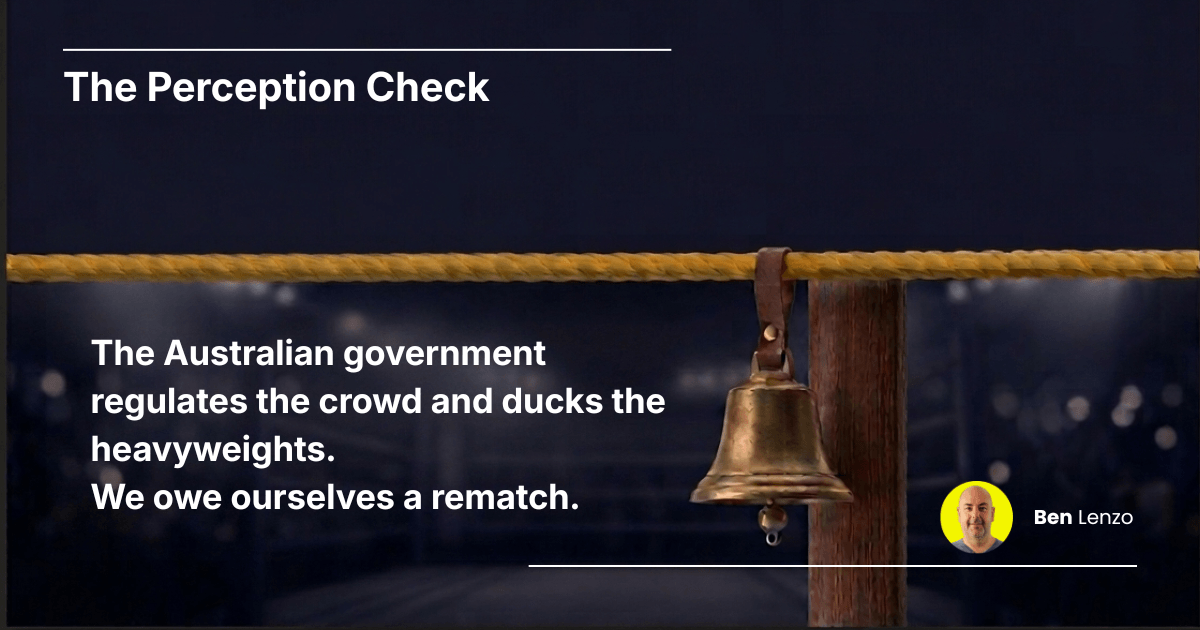
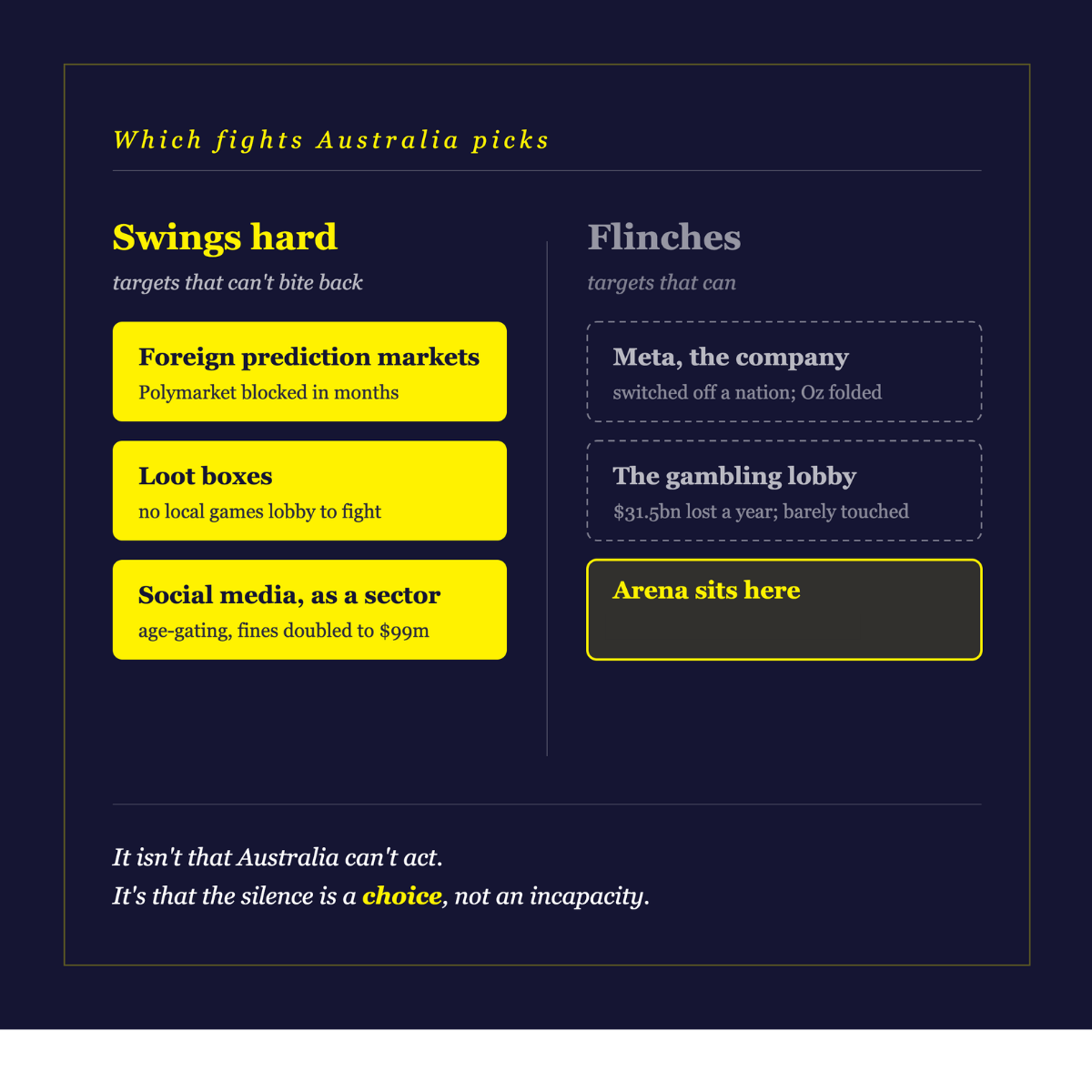
Here's the tell about how Australia actually regulates: We pick a fight with a target that can't hit back.
A foreign prediction market with no local constituency (Polymarket).
Loot boxes, in video games (absent a strong local lobby).
Social media platforms as a faceless sector - where the politics are a 77-percent public supermajority and no single company wears the blame.
On all of those, Australia has moved fast and swung hard. Booya for us! Patriotism and all that…
What Australia will not do is get in the ring with a single company that can retaliate against the entire country overnight. Or with an industry fused to its own revenue, its own sport, and its own state coffers. On those two, it flinches. Every time, so far.
Mark Zuckerberg has just greenlit a product that is likely to bite many in the ass. Though, not Meta shareholders of course.
If it looks, walks, and quacks like a corrupt duck
In June, a Wall Street Journal investigation reported that Polymarket, the largest prediction market on earth, paid creators to film themselves winning big on bets that were never placed. The trades were staged on near-perfect clones of the Polymarket site, one of them on a lookalike domain with the letter "l" swapped for an "i". The Journal reviewed 1,105 videos from ten creators. Around 70 percent showed a bet. None of the roughly $1.9 million in wagers was real. In 118 of the clips, creators celebrated nearly $900,000 in winnings on positions that, placed on the actual market, would have lost more than $166,000. The word "free" appeared in nearly a quarter of the videos. "Is this just free money?" was the line in 27 of them.
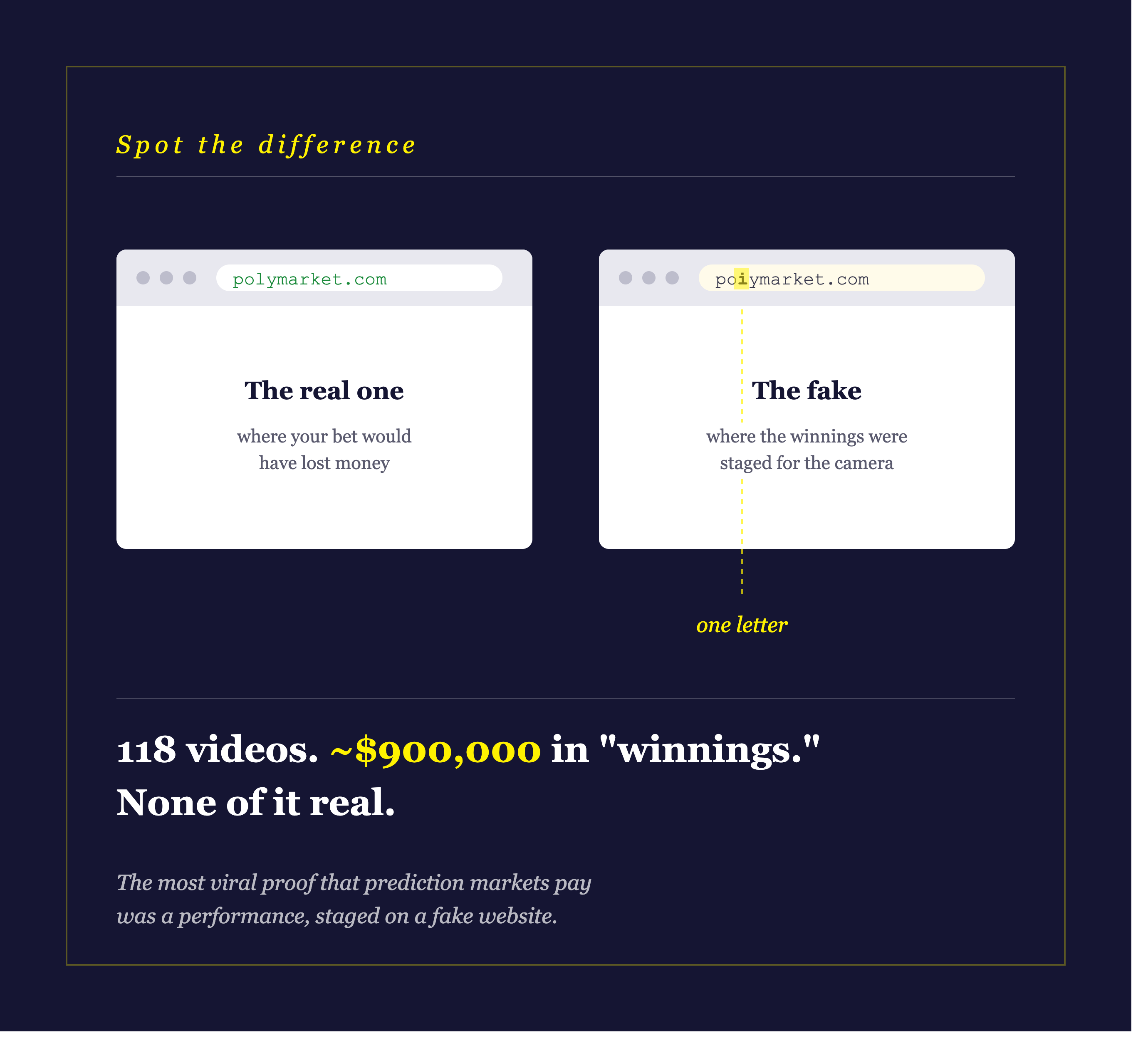
Polymarket says it's auditing its promotional content. We're all presumably in agreement that those findings will land just as soon as hell freezes over. Polymarket hasn't specifically addressed the simulated trades. The single most viral proof that prediction markets make ordinary people money was a performance, staged on a fake website, paid for by the company.
So, you know, if it looks, walks, and quacks like a corrupt duck, it's probably a corrupt duck.
But wait, because a bastion of corporate and social responsibility is about to enter the fray.
Welcoming a new contestant to the Arena
Last week the New York Times reported that Zuckerberg has greenlit a Polymarket-style app for Meta. Internally it's called Arena. Except it's not really a betting market. Well, not for real money. Well, not yet. Maybe later. At launch, Arena reportedly won't use money at all. Users earn points for betting correctly. Cash, the sources said, "could be added later". The points will presumably be used as Meta-Bucks or some bs, but I’d be surprised if they don’t eventually at least have some material, transferable, value.
A prediction market, run by the most influential company on the planet, with its fingers resting on the algorithmic scales of Facebook, Instagram, WhatsApp, your web traffic, and your bowel movements. A company with a sterling record of abusing your data and your attention in ways they don’t disclose.
What could possibly go wrong?
What the consumer is actually buying
The pitch for prediction markets is that they're truth-discovery engines. Money demonstrates belief, people bet more honestly than they talk, and the resulting price is the most accurate forecast available. That's the intellectual case, and on a neutral platform it might hold up.
The reality for the person doing the betting is less romantic. A Wall Street Journal analysis found 0.1 percent of Polymarket accounts took around 67 percent of the profits. The 0.1% getting it all again, eh? A Columbia study estimated roughly a quarter of the platform's historical volume was likely wash trading, fake activity manufacturing the appearance of demand. And the integrity problem is a structural one: in April, a US special forces soldier was charged with allegedly using classified details about the operation to capture Venezuela's Maduro to bet on Polymarket, making more than US$400,000.
A moral philosopher quoted on the case named the danger precisely. It becomes especially dangerous, he said, when the people placing the trades also hold influence over the outcome, because it gives you an incentive to change the outcome to match the bet you've placed.
So we should be perfectly comfortable with Meta doing this. Right?
The org you'd least want holding these keys
Meta is not a neutral platform. It's one of a few companies on earth with the means to meaningfully (and easily) manipulate a market while profiting from that manipulation. Its own history, in its own documents, is a record of exactly that capability.
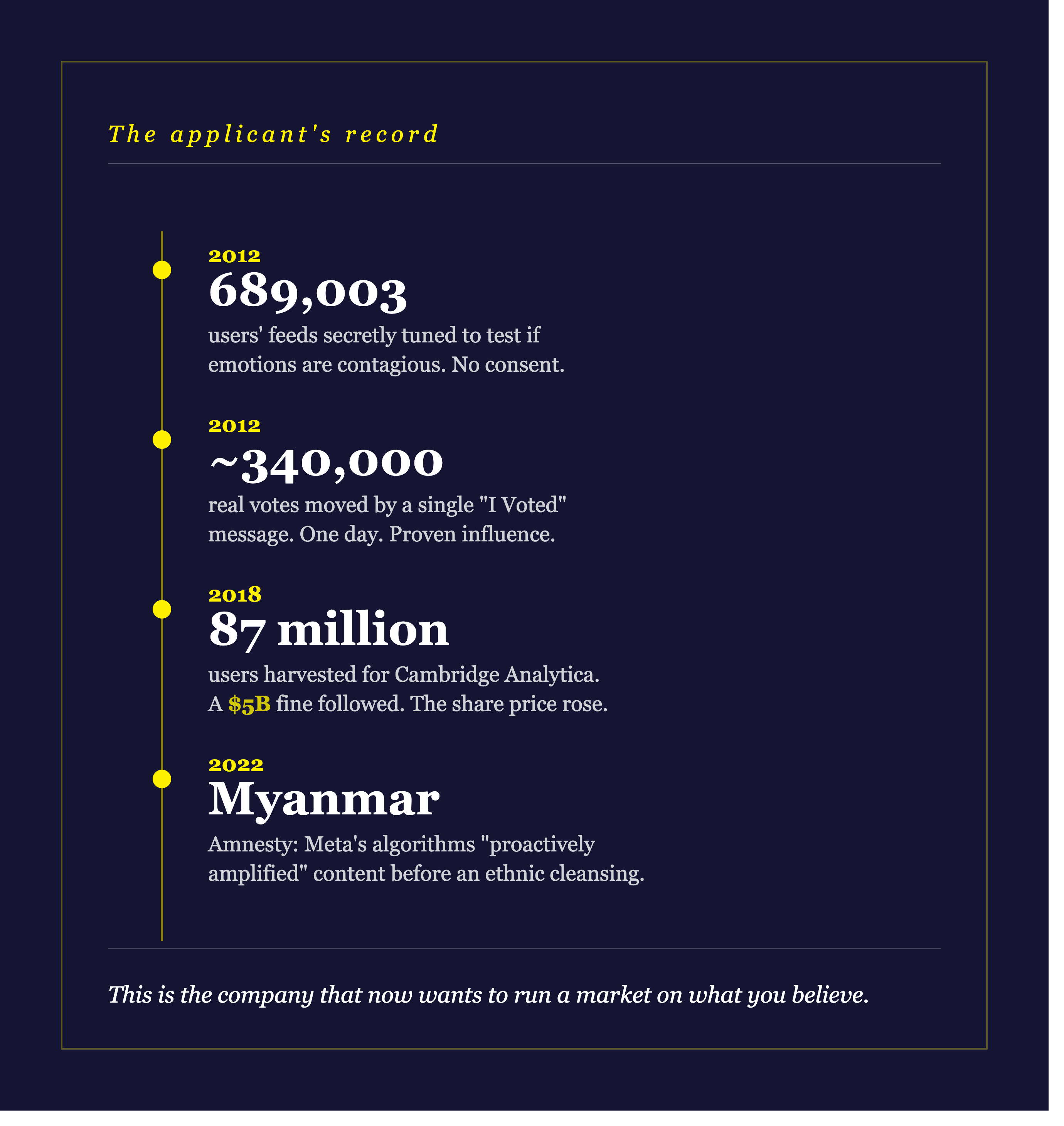
In 2012, Facebook's own researchers ran an experiment on 689,003 users, secretly tuning their feeds more positive or more negative, then measuring the result. Published in the Proceedings of the National Academy of Sciences, it found that emotions are contagious through a feed, and that Facebook could move them at will. No consent. No ethics board. That's the capability, demonstrated by Meta, on its own users, more than a decade ago, and things have only become more sophisticated since.
The same year, a study in Nature reported on a 61-million-user experiment Facebook ran during the 2010 US midterms. A single "I Voted" message showing the faces of friends who'd voted produced an estimated 340,000 additional real-world votes, verified against public records. One message. One day. A third of a million votes that didn't exist before Facebook decided to show people something. I'm not calling that one corrupt, unlike some of what follows. It's here purely to demonstrate their influence.
But we do have more corrupt examples. In 2018, the data of up to 87 million users was harvested for Cambridge Analytica's political profiling. The US Federal Trade Commission fined Meta US$5 billion in 2019, its largest privacy penalty ever. The share price went up on this news. Why? Because the fine represented approximately 7% percent of the company's annual revenue. A fine of 7% of revenue for one year against years or privacy abuses.
Meta posted a profit that year of approx USD $18.5B. Just the cost of doing business.
In 2021, the whistleblower Frances Haugen left with internal research showing Meta knew its 2018 engagement change rewarded angry, divisive content, and that European political parties had told Meta directly the algorithm was pushing them toward more extreme positions just to survive in the feed. And in 2022, Amnesty International concluded Meta's algorithms "proactively amplified" anti-Rohingya content in Myanmar in the years before the 2017 ethnic cleansing, in a country where, for most people, Facebook simply was the internet.
This is the company that wants to get into a betting market! A company with the proven, measured ability to shift what a population believes and does, now building the largest instrument ever made for measuring belief, starting with a version where it harvests the data while the winnings aren't even real. Just to be nice. Just to give people something to do.
The "no money" part of Arena provides no reassurance. A money-based market has a regulator watching (toothless though they may be depending on the jurisdiction). A points-based "game" has none. Meta gets to build the belief-and-behaviour graph in the regulatory gap, on the identity profiles it already owns, and decide later when to switch the cash on.
In the US, that regulatory gap is a cavalcade of fuckups! For example, various states are suing Polymarket over its practices, and the federal government is suing the states to stop them. It’s all angels playing harps on a bed of clouds…
But several thousand kilometres to the south, in the Land of Oz, we've already legislated against most of what Meta is reaching for, and what Polymarket and Kalshi have already done. And Australian governments of both persuasions have stoushed with Facebook, with social media more broadly, and with big tech before.
So, is there hope?
Australia has actually drawn these lines
Give the country (continent, damnit!) its due. On the specific questions Arena is built on, Australia has form, and mostly good form, as long as you notice which targets it chose.
On prediction markets, we didn't dither. After a Crikey-prompted investigation, the Australian Communications and Media Authority examined Polymarket and rejected its "we're a financial product" argument outright - the very argument that's worked in the US. ACMA found users weren't engaging with a financial instrument, they were staking money on yes-or-no outcomes for profit. That's what we call gambling, kids! It directed every Australian ISP to block Polymarket in August 2025, onto a blocklist now near 1,300 sites. Kalshi read the room and self-restricted Australian users.
Note the target of the regulator, though: a foreign operator with not a single Australian voter or sponsor to lose.
On the "no money, just points" mechanic, Australia got there even earlier, through the loot-box fight. From September 2024, with unanimous agreement from every state and territory, games with paid chance-based mechanics like loot boxes carry a minimum M rating, and games with simulated gambling, social-casino style, are restricted to adults at R18+.
Why?
Government-commissioned research found young people who played simulated gambling games were 40 percent more likely to spend real money gambling as young adults, and that even viewing and opening loot boxes correlated with problem gambling. The defining feature of a regulated "social casino" game is that no money or thing of value can be won. That is Arena's reported design, almost to the letter. Australia has already decided money-free gambling simulation isn't harmless, it's a training pathway into the real thing.
Note the target again: an offshore games industry with no domestic lobby.
On social media itself, Australia went first in the world. From 10 December 2025, under-16s can't hold accounts on the major platforms, Meta's included, with fines for companies that don't take reasonable steps. By June 2026, platforms had removed more than 5 million under-16 accounts. And when the ban looked under-enforced, the government didn't retreat, it escalated, announcing on 28 June 2026 that it would nearly double the maximum penalty to A$99 million (eh, still tiny, but ok…)..
Australia has faced down Meta directly before. Sort of. In February 2021, fighting the News Media Bargaining Code, Facebook simply switched off news for the entire country, blocking Australians from viewing or sharing it, and on the way out it took down the pages of emergency services, health departments, and domestic violence charities. The prime minister called it arrogant. The ban lasted five days, and it was the government that blinked, making the concessions, after which the code passed and Meta kept the right to decide whether news appears on its platform at all.
Read that honestly and it isn't a story about Australia bringing Meta to heel. It's the opposite. Meta proved it will weaponise its own platform against a sovereign government to protect a margin. That it'll knock the ambulance service offline to do it, and that Canberra will fold inside a week. The lesson the government actually banked wasn't "we can win." It was "don't provoke this company." Right on cue, Meta is now letting its Australian news deals lapse, and a second blackout isn't off the table.
So the regulatory instinct exists, and it has teeth. It just only ever bares them at things that can't bite back.
The thing Australia won't touch
For all of the above, there's one target Australia has never gone near: the domestic gambling lobby. And that omission is the whole reason the country drowns in the stuff.
The numbers aren't subtle, and they expose the lie in treating "no-money gambling" as the serious threat while real-money gambling runs free. Australia has the highest per-capita gambling losses on the planet. In 2022-23, Australians lost $31.5 billion, around $1,527 a head. 31.5 BILLION CLAMS! That’s a lot of clams! We are under half a percent of the world's population and hold close to a fifth of its poker machines.
The political response to that has been what we in Australia would call “piss-weak”. A multiparty committee whose unanimous June 2023 report made 31 recommendations into gambling, the flagship being a full ban on gambling advertising. The government sat on it for nearly three years. When it finally responded in 2026, it produced a partial ad restriction, not the ban, and tabled the full response on budget day - a day where obviously, it’s a slow news day, right? They deliberately buried it, arguably because they knew it was a gutless move. The government's own department estimated the partial measure would reduce wagering by under 1 percent.
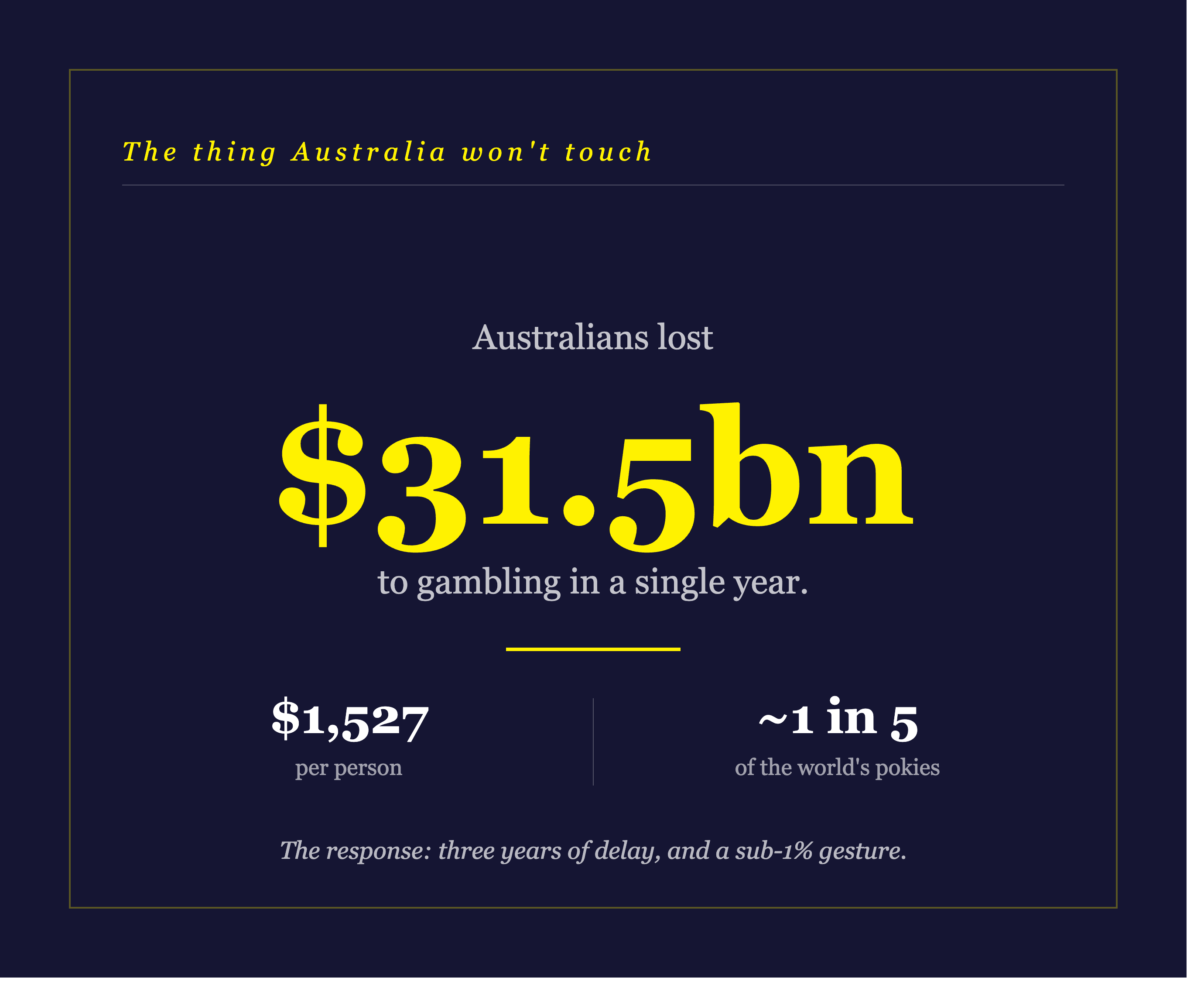
Now, let’s look at the two things here:. We will block a foreign prediction market in months. We will age-gate the entire internet for under-16s and double the fines when it's ignored. We can occasionally stare Meta down, right up until Meta stares right back, unblinking, and we fold. But the home-grown gambling machine, the one actually emptying $31.5 billion a year out of Australian households, the one teaching kids that the footy and a punt are the same thing, gets three years of delay and a sub-1-percent gesture.
It isn't that Australia can't act. The loot-box laws, the Polymarket block, and the age-gating fines prove it can act with real teeth. Which is exactly what makes the gambling silence a choice, not an incapacity. We are vigilant about the imported novelty and asleep at the wheel on the domestic epidemic, because the novelty can't fund a campaign or sponsor a stadium, and the epidemic does both.
And Arena is engineered, whether by design or dumb luck, to sit in an overlap here. It's run by a company Australia is scared to provoke, and it's a gambling product, the one category Australia protects. Both things put Australia governments knickers in a twist!
The age-gating fight is the control case that proves the country can swing hard when it chooses to, which is what makes the above inaction a choice, not an incapacity. Meta is about to build a points-based "game" that's a prediction market with a loot box, run by the company with the world's most documented record of surreptitiously moving belief, aimed at the most gambling-soaked population on earth, walking straight into the one gap the regulator has spent years declining to close.
A mouthful, I know. But that's the scale of it.

Let me bring this back to you and why you're here - and this one might not apply to everyone. And it’s more of a thinker this week, rather than a specific task.
I want you to think about which fights you’re going to pick and which you’re going to pass on. Sometimes - sometimes - you should be standing up for something that might seem counter-intuitive to your business in the short term, if it’s for the greater good! Not necessarily, your personal good, but the greater, societal good.
That might sound like blasphemy to some of you, but that’s what I believe.
So what’s the thinking you might have swallowed for years because it’s easier for you to do so, but maybe niggles away at you in the background. Take a look at why you’re doing what you’re doing, and whether that decision aligns with your values.
If it doesn’t, is that something you can work towards aligning?
Annnnnd, GO!
Glad you're here
Ben
#BeAVillager
References
Listed in order of appearance. Where a claim rests on a single primary source it's marked; where it's a reported allegation it's flagged as such.
- Polymarket staged-winnings investigation - Wall Street Journal investigation, 21 June 2026, reported across TechCrunch ("Polymarket reportedly paid creators to post deceptive videos about fake bets," 21 June 2026), Legal Sports Report, Fortune, AGB, TechSpot. Figures (1,105 videos, ten creators, ~70% showing a bet, ~$1.9m in unreal wagers, 118 clips depicting ~$900k in winnings that would have lost >$166k, the "poiymarket.com" lookalike domain, "free" in ~a quarter of videos, "Is this just free money?" in 27) all attributed to the WSJ review.
- Polymarket profit concentration (0.1% of accounts / ~67% of profits) - Wall Street Journal analysis, cited via SBS The Feed coverage of prediction markets in Australia.
- Wash-trading estimate (~25% of historical volume) - Columbia University study, cited via the same SBS/secondary coverage.
- Maduro-operation insider-betting charge (US special forces soldier, >US$400,000, April 2026) - reported via SBS The Feed and US outlets; charging document referenced in those reports. Name: Gannon Ken Van Dyke.
- "Influence over the outcome" quote - Dr Alex (Aleksandr) Piovarchy, moral philosopher, quoted by SBS The Feed.
- Arena (Meta prediction-market app, points-not-money, "cash added later") - New York Times, reported w/c 22 June 2026, via TechCrunch summary of the NYT report.
- 2012 emotional-contagion experiment (689,003 users, feeds tuned, no consent) - Kramer, Guillory & Hancock, "Experimental evidence of massive-scale emotional contagion through social networks," Proceedings of the National Academy of Sciences (PNAS), 2014. Primary, peer-reviewed.
- 2010 voter-turnout experiment (61m users, est. 340,000 extra votes) - Bond et al., "A 61-million-person experiment in social influence and political mobilization," Nature, 2012. Primary, peer-reviewed. The 340,000 is the authors' own estimate, not a counted figure - keep "an estimated."
- Cambridge Analytica (up to 87m users) and US$5bn FTC fine (2019) - FTC and US DOJ official statements, 2019. The ~9%-of-2018-revenue framing and post-settlement share-price rise via contemporaneous CNBC / CBS reporting.
- Haugen / 2018 engagement-change internal research and European political-party complaints - Frances Haugen disclosures, 2021; reported via CBS 60 Minutes and European Parliament testimony.
- Amnesty "proactively amplified" anti-Rohingya content - Amnesty International, The Social Atrocity: Meta and the right to remedy for the Rohingya, 2022. UN Independent International Fact-Finding Mission on Myanmar (2018) separately found Facebook a "useful instrument" for the violence.
- US state-vs-federal prediction-market litigation - reported via TechCrunch/NYT and AGB coverage of Kentucky AG suits against Polymarket and Kalshi, and the federal countersuits. Worth a fresh check on current status before publication.
- ACMA Polymarket finding and ISP block (August 2025, blocklist ~1,300 sites) - Australian Communications and Media Authority, following Crikey investigation. Kalshi self-restriction reported alongside.
- Loot-box / simulated-gambling classification (M minimum; R18+ for social-casino; from September 2024; unanimous states/territories) - Australian Government, Standing Council of Attorneys-General decision. The 40%-more-likely figure: Australian Institute of Family Studies research, cited in the government's classification announcement. Loot-box / problem-gambling correlation: Australian Gambling Research Centre.
- Under-16 social media ban (from 10 December 2025; ten platforms; >5m accounts removed by June 2026; penalty raised to A$99m on 28 June 2026) - eSafety Commissioner; penalty increase via IBTimes UK, 28 June 2026, and ABC News ("Social media age ban fines raised for tech giants," 30 June 2026).
- 2021 Facebook news ban (February 2021; five days; emergency-services/charity pages blocked; government concessions; code passed) - Meta newsroom post ("Changes to Sharing and Viewing News on Facebook in Australia," 17 February 2021); NBC News; Jurist; Universal Rights Group. Meta letting Australian news deals lapse (2026): The Conversation, January 2026.
- Australian gambling losses ($31.5bn in 2022-23; ~$1,527 per head; ~0.5% of world population, ~1/5 of world's poker machines) - widely reported Australian gambling-harm statistics; per-capita-losses-highest-in-world figure is well established, Equity Economics.
- Murphy report (unanimous, June 2023, 31 recommendations, flagship ad ban) and the government's 2026 response (partial restriction, tabled on budget day, est. <1% reduction in wagering) - House of Representatives committee report chaired by the late Peta Murphy; government response and criticism via The New Daily (13 May 2026) and SBC News (8 April 2026); the <1% estimate from the Office of Impact Analysis / relevant department.