
At a business awards night a while back, I watched a winner accept their trophy with a two-minute speech about how brutal the year had been. Costs up, conditions tightening, everything getting harder. Then came the closing line: "We had a better year this year than last year. But it was really hard."
A better year, delivered as a hardship story. The room nodded along, because inside the room that sentence is normal. And I say this as someone who took home an award that night myself, so I'm writing from inside the tent… Somewhere between the main course and the raffle, it struck me that the way business talks about difficulty has come loose from the way most Australians live it.
Autopilot Outrage
Which brings me to the capital gains tax changes, and the outrage I keep declining invitations to join.
You know the stories by now. More than 30 peak bodies signed a joint letter calling the reforms a penalty on investment. A #StopTheTechTax petition warned of startups, talent, and capital fleeing offshore. Opinion pages filled up with capital flight and brain drain. The Coalition has promised repeal. But, details being pesky, the carve-outs landed on a Thursday and the joint letters kept arriving the following week - which tells you the outrage was running on autopilot. The grievance had been partly answered, and nobody told those peak bodies.
Could be worse. LinkedIn could still be in uproar. Oh, wait…
A Policy Reversion, Not a Raid
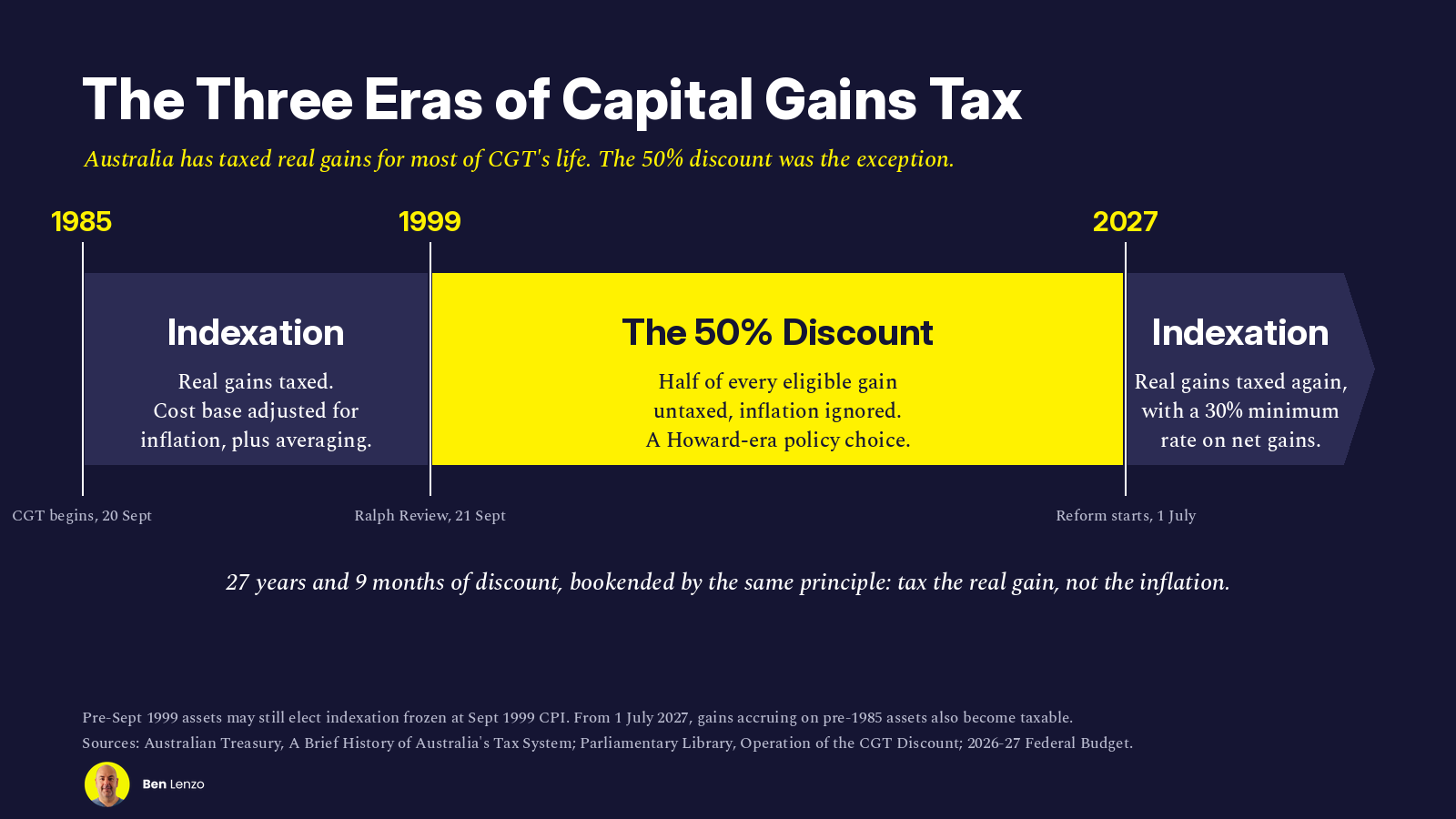
But the part that gets so often missed is that taxing real gains above inflation is largely how Australia taxed capital gains before 1999. It’s not a raid that brings down the sky. It’s a policy reversion. For 27 years we have taxed a dollar earned through wages more heavily than a dollar earned by holding an asset, and we have talked about that arrangement as though it were a law of nature. It’s not! It’s a Howard-era policy choice. And policy choices can change with the times. Reasonable people can debate whether the old settings were better. But "the government is confiscating our future" is not a debate, it is a tantrum.
And the average Joe and Jane can tell the difference. Two in three Australians backed changing these settings before the budget even landed. Across every demographic the pollsters measured, including the people paying a third of their income to a landlord. So, the outrage was always going to be a minority position.
Two things sit underneath my refusal to join in.
The first is that the outrage only ever counts one side of the ledger. The “bravest” version of the argument ends with a threat to move overseas, as though Singapore or Austin were a costless upgrade. Off you pop, then. Just price the whole move and living expenses before you book your flights. Price the health insurance that replaces Medicare, the school fees that replace a public education system, the security you currently get every time an ambulance turns up without a five-figure bill attached.
It is the subscription fee for the country you built your business in, and by global standards the product is very good.
The second is harder to say out loud, so I will say it carefully, fully understanding that everyone's story is different: Business people understand a particular kind of struggle, and it is real. Making payroll at 2am with your house on the line is not nothing, and I will never pretend it is. But it is a different category of struggle from the ones playing out in the same cities and suburbs our businesses trade in. On the whole, we have not gone hungry. We have not slept in cars. Most of us are not dealing with a terminally ill child, while managing a violent household and an eviction notice all in the same fortnight. When our sector reaches for catastrophic language over a change to an investment discount, the people living with actual catastrophe hear us clearly. And they wish for our problems!
None of this means the reform is flawless, and honesty demands that concession. Founders have a genuine grievance: when your cost base is close to zero because you contributed ideas and years rather than capital, indexation does almost nothing for you, and the tax bill on an exit can look brutal next to the old discount.
The government has acknowledged the problem and, unlike the joint letters suggest, actually moved: the $2 million turnover threshold for the active asset reduction is being lifted to $10 million, the small business CGT concessions survive, and a consultation on an innovative business concession that would preserve the 50% discount is underway.
So here is the operator's move, as opposed to the commentator's. Stop betting the farm on repeal. July 1, 2027 is a date, not a hypothetical. Model your exit scenarios under the new rules (as they become clear), get advice on the hybrid treatment for assets you already hold, and put a submission into the consultation if the founder cost-base issue affects you. Outrage is not a plan. A valuation and a timeline are a plan.
And one more thing, from that same awards night.
The programme also honoured community organisations, the kind doing unheralded work for people fighting battles most of us in that room will never see up close. If the business community wants its credibility back, that is where it gets earned. Give them your time, your money, or your skills, because it matters to living, breathing humans in your community. Credibility is a finite asset. We can keep spending it defending a tax discount minted in 1999, or we can invest it somewhere with a better return.

A bit more generalised this week...
Consider whether you only look at one side of the ledger on this issue?
Left column: what it actually costs you. Not the vibe, the number. If you can't put a number on it, write "don't know yet" and sit with how much outrage you've spent on a figure you haven't calculated.
Right column: what the same system hands you. The Medicare visit that didn't bill you. The courts that enforce your contracts. The roads your product moves on, the schools educating your next hire.
Annnnd Go!
Ben
#BeAVillager