
More than 10,000 babies.
That is the worldwide toll of thalidomide, the sedative handed to pregnant women in the 1950s and early 60s for morning sickness. Babies born with shortened or missing limbs, blindness, deafness, malformed organs. An estimated 40 per cent died within a year.
When thalidomide went on sale in Australia, there was no system for checking whether a medicine was safe before it hit shelves. None. The Commonwealth had no role in evaluating drug safety. The drug was legal, trusted, and completely untested by anyone accountable to the public.
Australia's response was to build an accountability system. The Australian Drug Evaluation Committee arrived in 1963, and the machinery it started eventually became the Therapeutic Goods Administration in 1990. Every clinical trial requirement, every approval delay, every form a pharmaceutical company grumbles about today exists because 10,000 babies died when there were no forms, and pharmaceuticals could just be sold as is.
And what do we call that system now?
Red tape.
The mechanism: Pre-loaded words
Psychologists call it priming. You hear a word and your brain delivers the entire package of associations before conscious thought gets a vote. Daniel Kahneman called this the associative machine.
And some people build these machines for a living - on purpose. Frank Luntz, the American pollster, engineered "death tax" as the replacement for "estate tax". Same tax, new word. And support for scrapping it jumped, because nobody wants to be taxed for dying. He also advised swapping "global warming" for "climate change" because it sounded less frightening. The words did the persuading, so the arguments never had to.
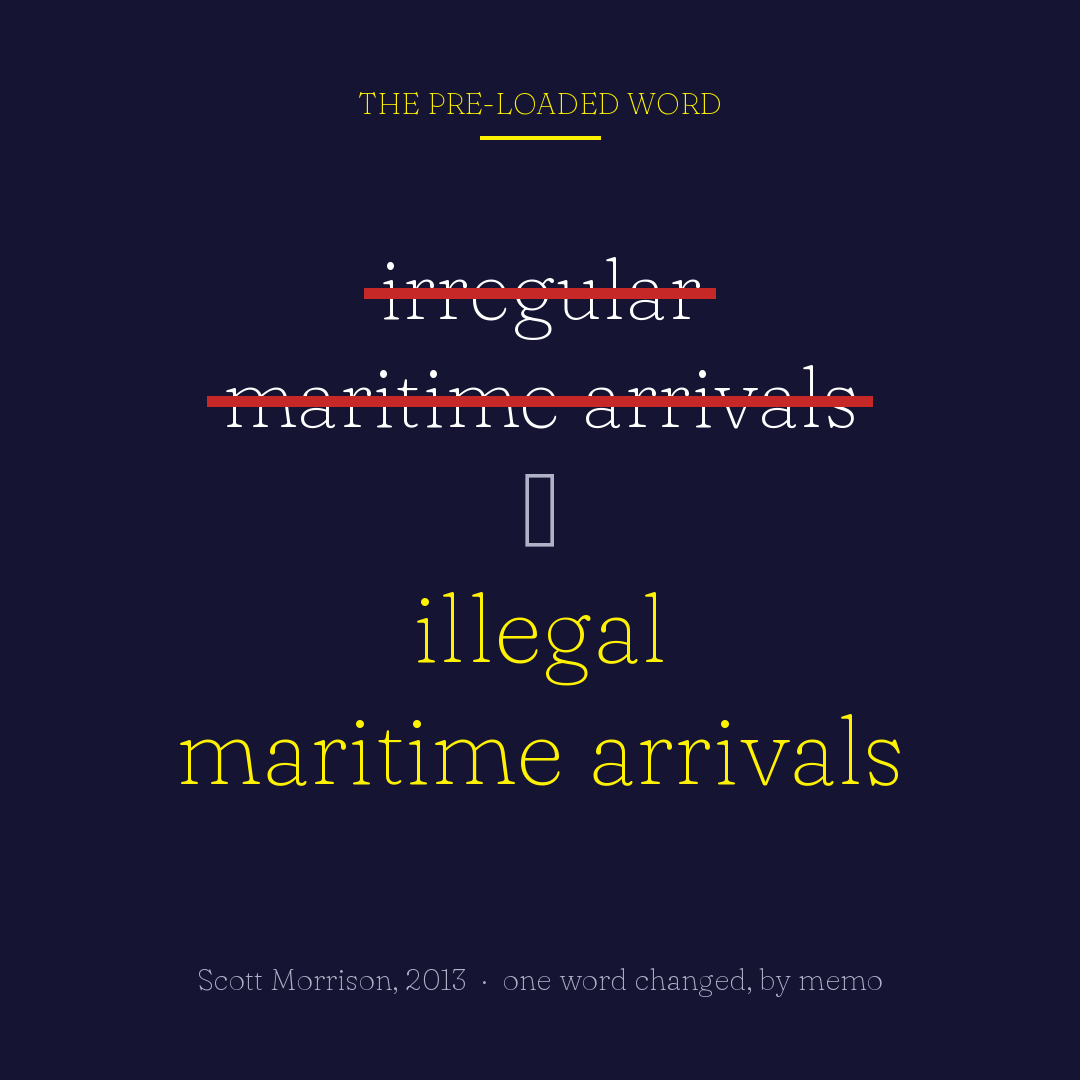
We do it here too. In 2013, Immigration Minister Scott Morrison issued a directive to his department: people arriving by boat were no longer "irregular maritime arrivals" - they were "illegal maritime arrivals." One word changed, by memo. The verdict now arrived before the facts did.
"Red tape" is the perfect specimen. Say it and the listener has already heard waste, delay, bureaucrats, forms for the sake of forms. Nobody defends red tape, so nobody has to define it.
It’s the opposite of when you’re in school and your maths teacher says you have to show your work. Not with this bad boy. “Oh, blimey, the red tape.” See, you get it, and you didn’t even need to carry the 1.
Try another. Say "farmed salmon" and the picture arrives just as fast, only this time it is dirty pens and antibiotics. Whether a specific operation is well-run or a disgrace never gets a hearing, because the word already voted.
This is why genuinely new thinking is nearly impossible in the news. A pre-loaded word fits in a seven-second grab. Unloading one takes 400 words of nuance, and nobody in a news cycle has 400 words. So public debate runs almost entirely on words that arrive pre-packed, and the packing was done years ago by people packing agendas.
The business version
You watched this play out in your own inbox two weeks ago.
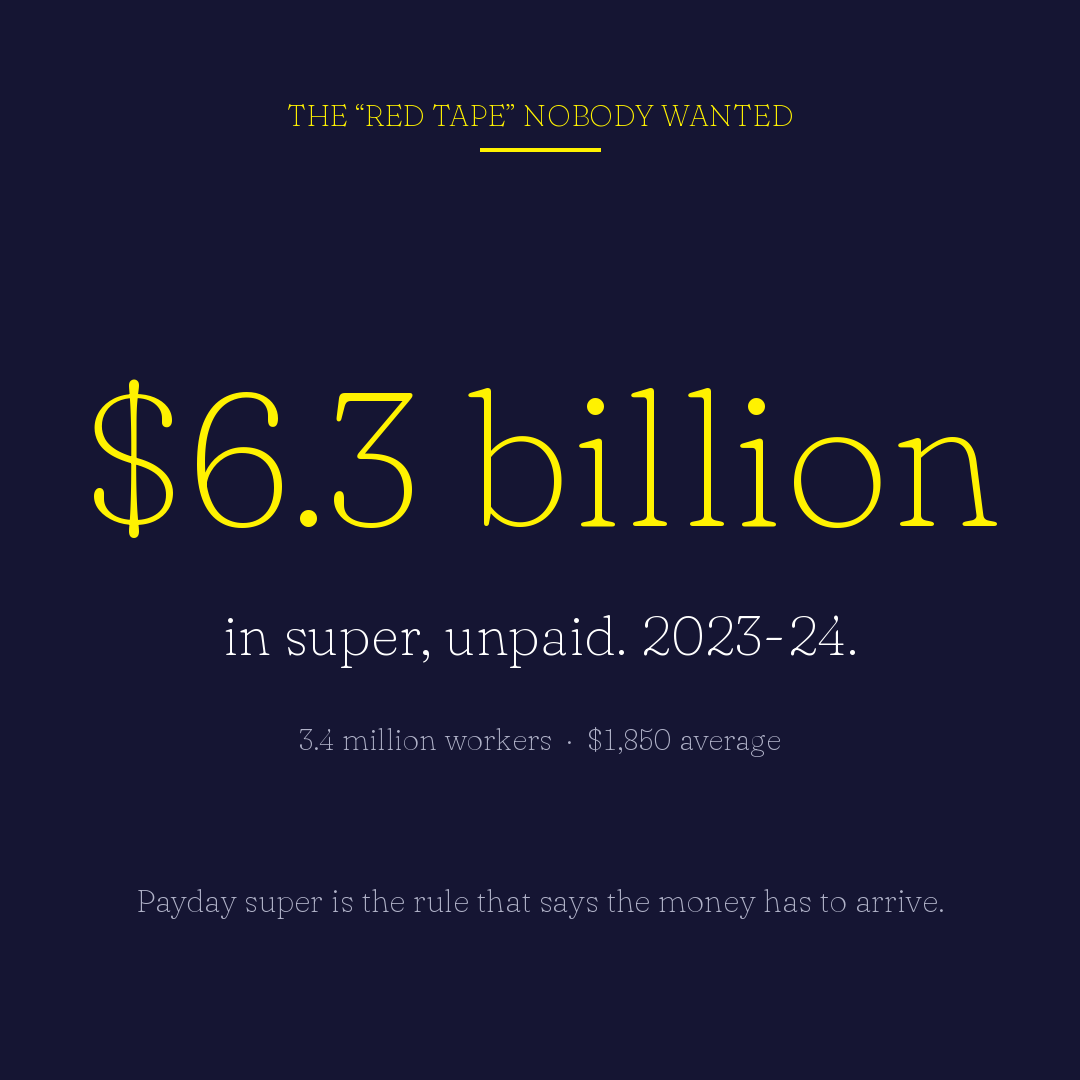
On 1 July, payday super landed, and the commentary called it what commentary always calls new obligations: more red tape for small business. But, here are some hard numbers and hard truths. Unpaid super hit $6.3 billion in 2023-24. Around 3.4 million Australian workers, roughly 28 per cent of employees, were underpaid an average of $1,850 each. The "red tape" is a rule that says the money you already legally owe your staff has to actually reach them.
Same thing in the banks. Responsible lending obligations were dismissed as red tape for years, right up until the Banking Royal Commission found fees charged for no service, including to dead customers, with remediation running into the billions.
Red tape is what a regulation gets called by the people it inconveniences.
Protection is what it gets called by the people it saves.
Same rule. Different word. The word decides the debate.
The post-COVID punchline
The bleakest version of this is playing out right now.
A growing crowd rejects "big pharma red tape" in favour of cures that have never been through a clinical trial. RFK Jr, the U.S. Secretary of Health and Human Services, has spent years questioning vaccine safety while a measles outbreak killed unvaccinated children.
Oh. The. Irony. The system these people are fleeing was built because an unregulated drug maimed more than 10,000 babies. Thalidomide was the safe, sedative everyone trusted. The rigorous testing regime is not the danger they escaped. It is the scar tissue from the last time there wasn't one.
And thalidomide itself? Still legally sold in Australia today, under the brand Thalomid, for a type of cancer of the bone marrow. It sits behind some of the strictest prescribing controls of any medicine in the country - which makes it possibly the most red-taped drug in Australia. The red tape didn't ban the drug. It made the drug usable.
Most of us aren't regulating global pharmaceuticals, but we play out this exact same drama on a smaller scale every day.
The D question
Every business runs on pre-loaded words too. "Compliance." "Admin." "Overhead." "Legacy." Say one in a leadership meeting and that frame arrives fully built: cost, drag, cut where possible. Nobody in the room likely built that. It’s legacy. Baked in, baby!
This is the whole premise of Challenge The Frame. Watch what each archetype does when a loaded word lands. The Bystander sees the problem clearly and still lets the word decide - the meeting agrees, so they agree. The Bouncer has the fire to fight it but swings at the word instead of the frame, then goes for a different word after getting distracted. The Builder does something else - they take the frame as given and methodically optimise inside it, building beautifully on a foundation nobody checked. Only the Breaker asks the question the word was designed to prevent: What is behind this word, and what is it (potentially) assuming?
Here's the Different question - and it's a reversed one. Don't ask which processes you should cut. Ask which one you already did. Somewhere in the last few years, you killed a process because it was boring, slow, and nobody could remember why it existed. The double-check before invoices went out. The second signature. The monthly reconciliation someone automated away without reading first. It felt like a win. It went in the board report as efficiency. And that may have been the right move.
But that process was likely built after something went wrong - and the person who remembered why was likely let go two restructures past. You might have taken the batteries out of the smoke alarm because the beeping was annoying.
Thalidomide was sold into a market with no checks because checks seemed like unnecessary friction. The TGA is what got built from the wreckage. One of those is the cautionary tale and one is the system that means it never happens again. Be the TGA, not the thalidomide.

This week's one thing
Go through the last two years and find one process you killed. A check, a sign-off, a report, a reconciliation - something that died because it was slow and nobody could be bothered doing it. Then answer one question in writing: what failure was it built to prevent?
If the answer is genuinely nothing - it was ritual, a relic, a form for the form's sake - good kill. Take the win.
But if you trace it back and find a body - a bad hire, a blown deadline, a client who walked, an invoice that never got paid - you've just found your thalidomide moment before it happens. Reinstate it, or build the modern version of it, this week. Build the protection it existed to deliver.
The cheapest time to find out what a smoke alarm was for is before the fire.
Annnnd, GO!
Ben
#BeAVillager
Sources
- TGA, "What is the Therapeutic Goods Administration?" - thalidomide history, 10,000+ babies figure, 40% mortality estimate, absence of pre-market evaluation, current controlled supply: https://www.tga.gov.au/news/blog/what-therapeutic-goods-administration
- TGA, "A history of therapeutic goods regulation in Australia": https://www.tga.gov.au/resources/publication/corporate-reports/history-therapeutic-goods-regulation-australia
- Super Members Council analysis of ATO data, 2023-24 - $6.3 billion, 3.4 million workers, $1,850 average, 28 per cent of employees (reported by Financial Newswire and Super Review, July 2026)
- APRA, "Payday Super Readiness" - ATO estimate of over $6 billion unpaid, 1 July 2026 start date: https://www.apra.gov.au/payday-super-readiness
- Thalomid Consumer Medicine Information, Australian Commission on Safety and Quality in Health Care - https://www.safetyandquality.gov.au/medicine-finder/thalomid-capsules - and the Australian Product Information confirms sponsor and indications