
Welcome to Issue 3 of The Perception Check - by Ben Lenzo.
Earlier this week, I dropped a piece here about being on the cusp of a great opportunity with Ricky Gervais and an animated series of mine called The Four Horsemen (T4H). It had all the makings of a hit. It didn’t happen. What gets missed when I tell it is that it was one part of a larger business plan. And even if it had been a smash hit, it still wouldn’t have been a business. Not on its own.
In Issue No. 3: why a “hit” isn't a business, the three types of reinvestment (only one of which actually compounds), and why nobody is safe - including the disruptors who were the safe bet five minutes ago.
A Hit Is Not a Business. Ask Macarena.
Macarena was a song, a dance, a label, on repeat across every radio station, and a royalties machine that still pays today. Los del Río had real infrastructure - distribution, production, marketing, all functioning at scale.
What Macarena was not, was a business. Because nothing was ever built on top of it. Los del Río in 2026 are exactly what they were in 1996: the people who recorded Macarena - admittedly with boat loads of cash which is ace for them.
A hit is an event. A truly successful business must always see itself as needing to be a Transformational & Compounding one. The first line funds a second line that’s structurally different from the first, that loops back to compound with it. Without that loop, you’re a hit machine. The hit machine runs until the audience moves, and then you don’t. And that makes investing in your business difficult.
There are 3 types of reinvestment in a business. I call these the MAD Rules - More, Adjacent, and Different.
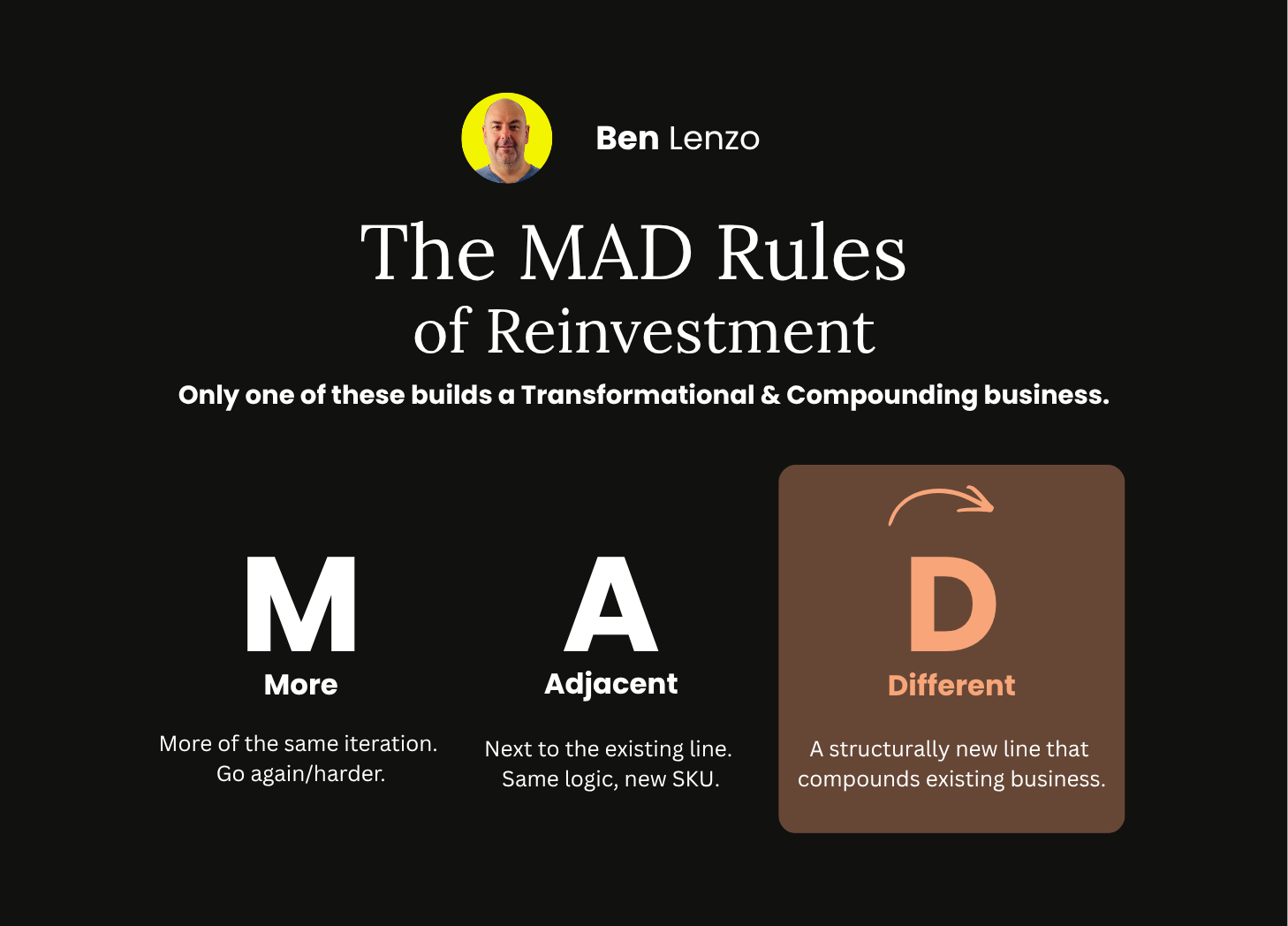
- More - reinvesting in more of the same. The next album, the next territory, new features. Macarena, product iteration.
- Adjacent - reinvesting next to the existing line. New SKU, similar customer, identical underlying logic. Apple Watch beside the iPhone.
- Different - something structurally new. A new revenue line that didn’t exist before, that transforms the business and compounds back into the original lines. (network effects).
The first two are fine. Often profitable. Neither builds a business that compounds. Only D does.
Apple didn’t just sell more iPhones. They built a second line that feeds the first. Services started as a small slice of revenue. Today it’s a machine in its own right. Apple Music, Apple TV+, Apple Pay, Apple Care. Each one stands alone. But more importantly, each one pulls you deeper into the ecosystem. Hardware drives Services. Services lock in Hardware.
That loop is the point.
That’s what a Transformational & Compounding move looks like. Not just more product. A different engine.
The Thinking Behind the Work
Standard consulting walks in and asks how to make your More bigger. Run the funnel harder. Tighten conversion. Wring more out of what’s already there. All useful. But you could likely do that with your existing team.
The better question - and the one we ask at The Perception Collective - is where’s your D?
Most operating businesses are sitting on at least one Different opportunity in plain sight. Years of infrastructure, customer relationships, data, distribution, and brand permission - all packaged into a single revenue line. The second line is in the room. Nobody’s named it yet. We don’t ignore the More or the Adjacent. But the Different is where you can transform your business.
That’s the work.
Where We’ve Done It Ourselves
Back to the LinkedIn piece, The Four Horsemen was the pointy end of a much larger thesis.
In 2009, the studios were terrified of piracy. Films and TV shows were being shared freely on torrents - software that let anyone download a movie for nothing. The studios’ answer was lawsuits, takedowns, ISP threats, copy protection. It wasn’t working for them, and according to them was costing them billions of dollars in lost sales. By the way, this was waaaay before streaming was a thing.
We were asking: what does this distribution channel become if we build on it instead of fighting it? People were using torrents because torrents worked - cheap, fast, no friction. The technology wasn’t the problem. The lack of a legal way to use it was.
So here’s what we wanted to do: launch T4H via torrent, legally, with advertising baked into the distribution itself. We owned the IP. Audiences used the tool they already preferred. Revenue came from the ads.
But T4H alone wasn’t a business. The actual business was applying the same model to studio content - and offering the studios two things they didn’t have: a new revenue line (a 70% split of the advertising revenue we generated), and a solution to the piracy problem they’d been spending fortunes on and losing.
Studios engaged (after first choking when they heard the word ‘torrent’). Disney, Fox and others signed on. We had taken what to the studios was a defensive cost line, and turned it into a revenue line.
Nobody’s Safe, By the Way
Canva (Australian, founded 2013) walked in and knocked Adobe sideways by asking the question Adobe was ignoring: what does design tooling become if non-designers can use it? Canva built to a broader client than Adobe.
Now look at the next hill.
Could Claude Design - or any AI-native design tool - do to Canva and Adobe what Canva did to Adobe alone? Probably. Almost certainly. The disruptor of one generation is the incumbent of the next. The behemoth is always one strategic generation away from being someone else’s feature. We didn’t have companies like OpenAI, or Anthropic just a few years ago.
Netflix was never gonna be bigger than Blockbuster.
Nobody was taking the phone biz away from Nokia.
Apple & Samsung were never gonna dominate Blackberry.
And yet here we are. Blockbuster, Nokia, and Blackberry are gone or definitely not what they used to be.
And it can happen to Netflix, Amazon, Google - who many of you may feel are unassailable, just like those others thought they were. Now, I will grant you, there are some structural/legislative issues that help our current behemoths, but the point is that being a Transformational & Compounding business isn’t a strategy, off-site exercise.
It’s a forever exercise.
What’s that thing over the next hill? The moment you stop asking, is the moment you should start looking over your shoulders at the company that is.

Pick your single most successful product, service, or revenue stream. The one that pays the rent.
Write down, in one sentence, the problem it solves for your customer. “Customers come to us when they need to ___.”
Then write three different questions a customer in that same situation might also be asking - that you’re not currently answering.
One sentence per question. Don’t grade them. Don’t decide whether you can deliver them. Just write them.
One of those three is your second line. Maybe your D.
48 hours.
Annnnnd, GO!
Tell me how you went on LinkedIn. I read the messages. And if you can’t do the above exercise, then definitely get in touch.
Glad you’re here.
Ben
#BeAVillager
P.S. The hardest part is telling More from Different from inside your own business. Both feel like building. Both pay the rent. The clue is whether anything structurally new is being built.
This week’s story - the Gervais call, in full unflattering detail - is a good read. It’s available here.