
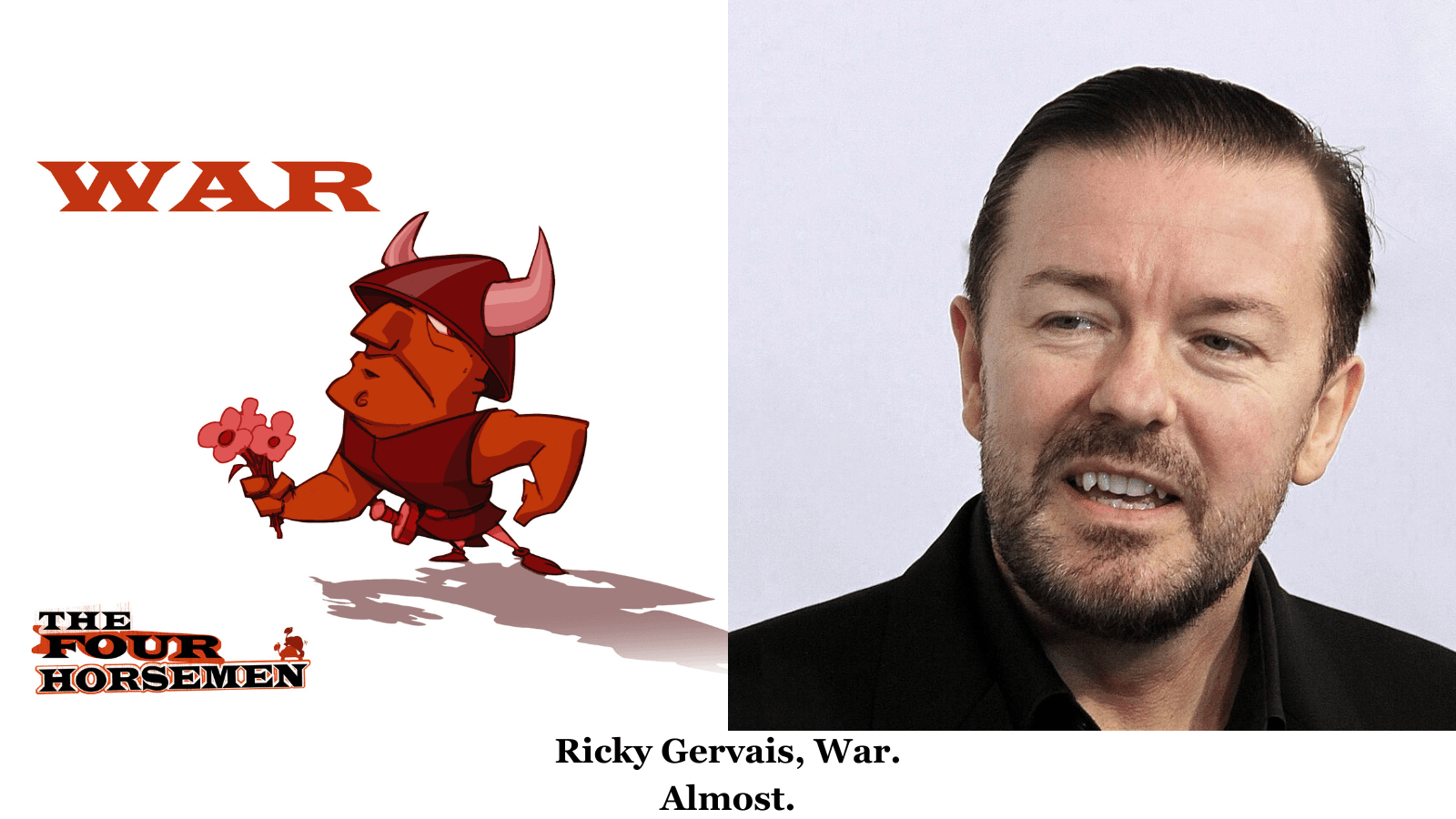
In 2008, I was developing an animated series called The Four Horsemen. The pitch: Jesus wants to modernise the family business. Instead of just punishing based on The Ten Commandments, he wants to expand this to racism, bigotry, generalised stupidity – things that don't break a commandment but actively make the world worse. God agrees that Jesus can take Four Horsemen on a test run, with one rule: no namesake powers. War can't start wars, Death can't kill on touch etc. They have to get creative! The pilot runs in Haven, Mississippi – a town so religious God figures nothing could go wrong, and so self-righteous Jesus knows everything will.
So, a black comedy about race, religion and politics. Ya know, super mainstream and family friendly.
I sent a script to Ricky Gervais's UK voice over agent. He loved it and agreed to voice War. Over a phone call to discuss the role he even asked if he could write an episode himself! Yes, Ricardo. You may, indeedy-do.
Once a deal was negotiated with Ricky, everything accelerated. Other names got interested too. Sarah Silverman, & JB Smoove. And we approached Louis CK's peeps for the role of Pestilence. They all wanted in!
The 3 Round Fight Before The Knockout
Round 1: Louis CK's manager, Dave Becky, decided to verify Ricky's involvement. He contacted Ricky's US agent to confirm. Ricky's US agent had never heard of it.
Now, in 2008 - a time before spouting BS with confidence was a ticket to a hit male-led podcast, and audacity wasn't on sale as much as it is now - the implication was real and ugly: this Aussie guy is making up Gervais's involvement.
Round 2: I went back to Ricky's UK voice over agent - the correct channel for VO work - and the one I'd gone through from the start. She confirmed in writing to all the other agents that it was legit. Becky's team came back: Gervais's US agent says it's not real. Again.
Round 3: The UK Voice over agent confirmed again. The US agent denied it again. Mother-puss-bucket!
I was staring down what felt like the end of the entire project, with credibility burned.
The Four Horsemen wasn't just a TV show.
It was the first real test of a much bigger idea I was working on. The studios were getting their pants pulled down by piracy at the time - millions of people downloading movies and shows for free via torrent sites. My pitch was the opposite of fighting it: use the exact same tech, but turn it into a paid distribution channel using The Four Horsemen as the spearhead.
So I called him. Direct. It was late. It went to voicemail. I left a polite message asking if he could help me resolve this - his US team was essentially telling people I'd made up his involvement.
And that voicemail killed the show.
The next morning, an email landed from Ricky's UK Main Agent (another agent in the mix). Copied to roughly every relevant party in the Northern Hemisphere. The gist: Ricky was out. Everything should have gone through an agent in the first place. Tone: Professional, but someone to be fucked with, I am not.
Show over. Gone. Poof!
Should I have called him? Eh, maybe not. But then again, is my word and my reputation worth more than a TV show, or a business? Yeah! It sure is.
I was right about what mattered. I was wrong about how to defend it.
CK's manager believing I'd fabricated a Ricky Gervais attachment was a serious problem. I wouldn't do business with me if I'd heard that. Defending against that was correct. It was worth more than the show.
A phone call to Ricky directly felt like it would settle everything in ninety seconds. The slower, better option - an email to everyone in the chain, on the record, restating the position from my side, with the UK VO agent's written confirmation attached - would have worked. It might have put some noses out of joint, but probably not Ricky's (and then again, if it had, do you wanna work with tossers?). This would have resolved the credibility issue without me ever picking up the phone.
I knew at the time that calling him directly was unorthodox. I did it anyway because I felt cornered. In that state, just getting it 'resolved' quickly felt like the right approach. That's almost never correct. Under pressure, I went for the speedy resolution instead of the quality one.
A big part of what The Four Horsemen need to 'unlearn' in their new situation is precisely this. They normally default to blunt force. War starts wars. Death kills on touch. The new rules strip that away - they try the old way once, on a cow, and the consequences are immediate and unpleasant. From then on they have to think. Plan. Get creative. And it turns out the longer path produces the more satisfying result.
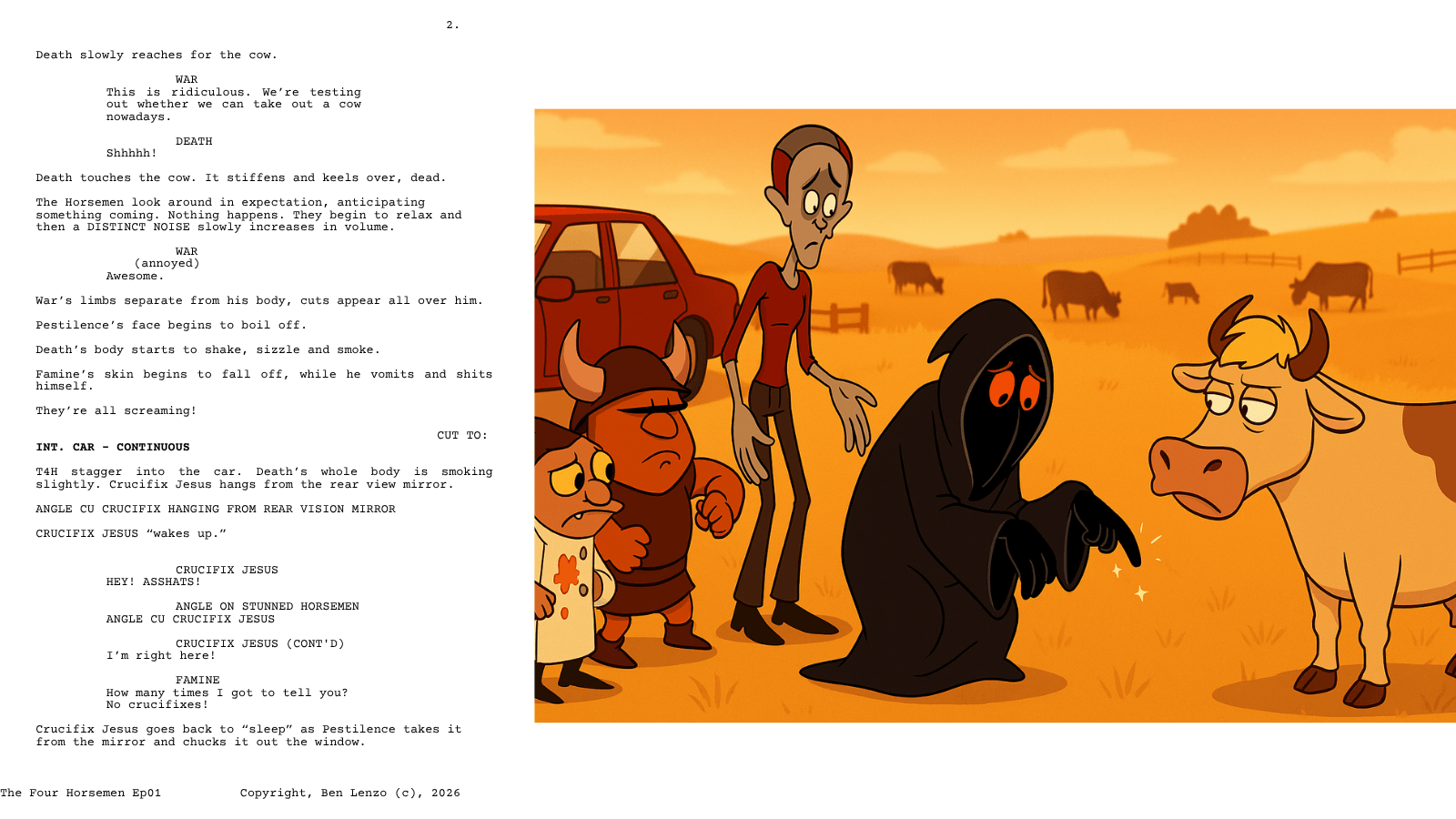
Sometimes, when you move quickly, you're just adding fuel to the fire. When you're trying to land a cast for a tv show, and when you're making a decision in your business.
Sound Familiar?
I see this pattern constantly. In different settings, but often. In many, early, client interactions - they come to us already in the hole, having made some bad decisions. Founders desperately chasing a deal, leaders managing one crisis after another, operators trying to plug a leak that turns out to be a rounding error in a much bigger problem. The pressure compounds, the attention focuses on the wrong thing, and the brain becomes reactive to 'putting out the fire.' But it doesn't solve the actual problem, and can create a bigger one down the road.
Noticing that you're cornered and perhaps not thinking clearly is a skill you learn. You're in a pickle, old chum! Force yourself to consider the slower, less satisfying move. It might not feel like (or in fact, be) an immediate fix. It will leave you with something unresolved. For the moment. And that's ok.
I didn't do that with Ricky.
The instinct to stand up and defend myself was right, but I picked the wrong tool. And it cost me. And you. Because the awesomeness of The Four Horsemen was not unleashed upon the world. And for that, I am truly-ruly sorry.
For founders: pressure compounds. Just solving the problem in front of you in the quickest way isn't always the right answer. Your biz is on the line - think it through.
For leaders managing a crisis: the urge to act decisively is natural. Just make sure you've considered all your options. Maybe take some counsel. Being decisive isn't always correct. Pausing is a useful tool.
For animation and comedy fans: The Four Horsemen gets pulled out and updated every now and then. Who knows if it will ever see the light of day. Perhaps as shorts on TikTok.
.png)