
I was consulting with a client and in a meeting with the executive team. The COO was being asked why the company still ran some (really inefficient) functions the way they did. His response was immediate.
“We’ve always done it this way.”
Now, personally, when I hear this it means we’ve got more work incoming. But it’s also always a little disappointing for the organisation, when it’s stated in this context. Because it means there’s been lost opportunities along the way.
There’s a particular kind of comfort in saying “we’ve always done it this way.” It sounds like wisdom: “The sacred org manual dictates that we hoc modo facimus quia hoc modo fecimus, et hoc modo faciemus."**(Latin: we do it this way because we did it this way, and this is how we will do it.)
It’s the comforting, considered judgment of people who know their business. Mainly, it does what it’s supposed to do. Shut down questions and get everyone back to work.
I always think it represents a sunken cost fallacy when it’s used like this.
What it really means is: we haven’t looked at this in a long time, and we don’t want to look at it now.
Here are three of those moments I’ve watched up close.
Six Hours Per Client
A community services provider I worked with was still running their client intake on paper. Handwritten forms, two pages, signed in triplicate. The intake worker would sit with the new client, fill it in by hand, then bring it back to the office, where someone else would manually re-key the data into the CRM and the funding system.
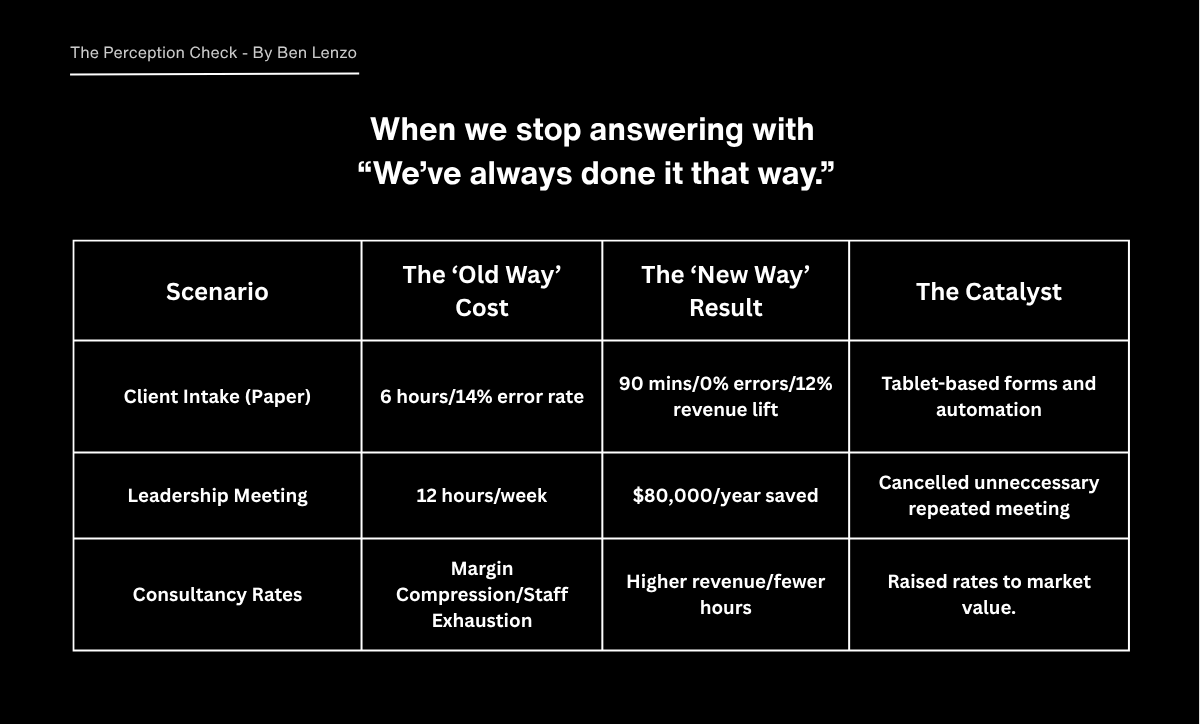
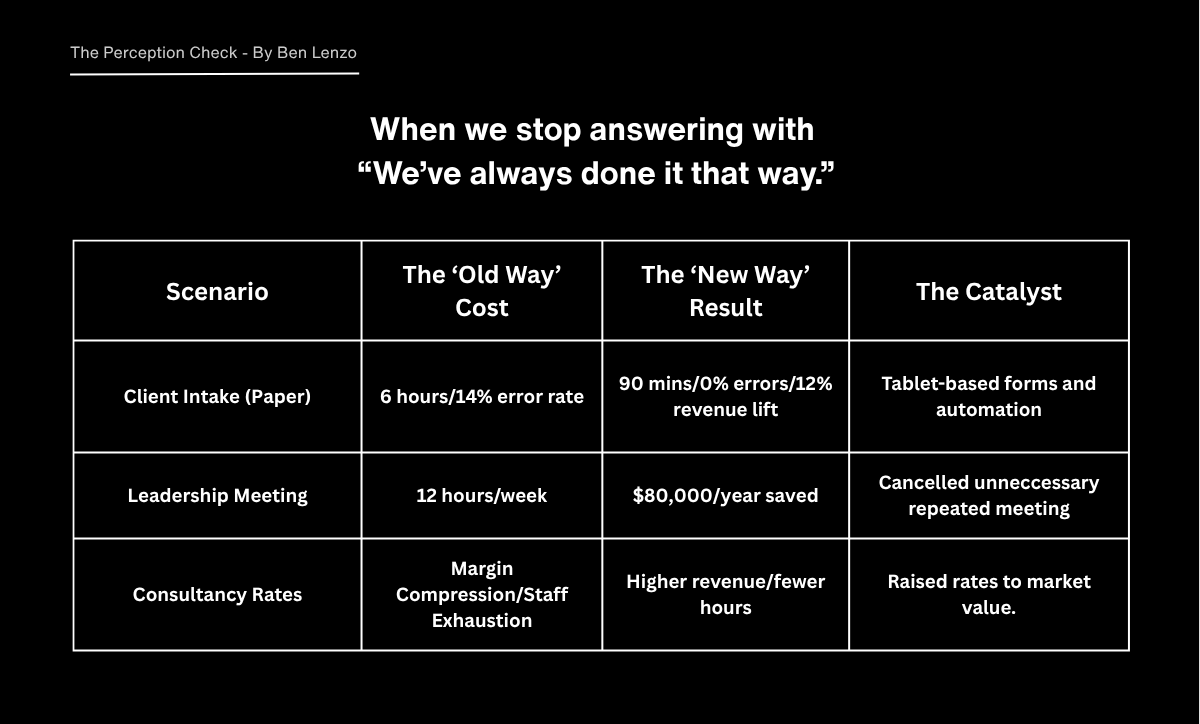
Total time per new client: about six hours, split across three people, 2 hours of which was the actual taking of information from the client.
When I asked why, the manager looked at me like I’d asked why water was wet.
“Well, that’s how we’ve always done it. The team know the form. The funders accept it. Why would we change?”
Why they would change, it turned out, was that the manual transcription was producing errors in funding category codes. Roughly one in seven submissions had a mismatch that the funder either queried or paid out at a lower category. They were leaving money on the table every week without knowing it.
We helped them move intake to a tablet-based form that pre-populated the CRM and the funding submission in one go. Time per client dropped from six hours to ninety minutes (all of which was the intake component itself). Transcription errors went to zero. Funding accuracy lifted. Total uplift in the first year was around twelve per cent of their annual income. That’s a big change!
The form had been in place for 8 years. They’d added a separate form on top, but the original had been the same for that whole time.
Ninety Minutes Every Monday
A professional services firm I knew had a leadership meeting every Monday. Ninety minutes. Eight senior people. Every week, without fail, for as long as anyone could remember.
It was sacred. Calendars cleared around it. Nobody had ever questioned it because everybody assumed everybody else thought it was essential.
When we asked what the actual outputs were from the meeting, the founder reacted as if the thought had not occurred to him. All the information being discussed was actually in their systems. Most of the time, there was not much new information being surfaced. Especially not enough to justify 90 mins a week from 8 highly paid people!
The founder cancelled them.
Nothing broke. Decisions still got made, in faster and smaller forums. Information still got shared, through better - existing - channels. The leadership team got twelve person-hours back per week.
At their loaded senior rates, that was roughly over $80,000 dollars a year in time. 80K in one bullshit meeting! 80K of senior leadership capacity that wasn’t spent on strategy, growth, or mentoring. And none of which had ever shown up as an expense, because nobody invoices you for a meeting that always happened.
The Monday meeting had been running for years.
The Rate That Hadn’t Moved
A consultancy was charging the same hourly rate they’d set three years earlier. Their own junior hires, when they left to start their own businesses, were quoting thirty per cent higher and winning the work.
The partners knew this. They talked about it occasionally. They never moved on it.
When I asked why, the answer was a variation on the theme.
“That’s our rate. That’s what our clients expect. That’s what we charged.”
What they’d always charged was anchoring the next generation of partners to a number that hadn’t kept up with inflation, let alone with the value the firm now delivered (which was significant). They were undercharging clients who would have happily paid more, and the gap was showing up in margin compression and staff exhaustion.
When they finally raised rates, three clients left. Over 30 stayed - the ones the firm should have been working with all along. Revenue went up. Hours went down.
Why the sentence is dangerous
Here’s the thing. “We’ve always done it this way” is usually true. That’s what makes it so seductive. So comfortable.
The form had been used for years. The meeting had been running for years. The rate had been in place for years. All three statements are accurate, and the people saying them weren’t lying or being lazy. They were describing reality.
The problem is that “we’ve always done it this way” answers a different question than the one being asked.
The question is usually should we be doing it this way?
The answer the sentence gives is we have been doing it this way.
Those aren’t the same answer. They’re not even close.
History is a description of what’s occurred. It’s not a recommendation. The fact that you’ve always done it a particular way tells you nothing about whether you should keep doing it. It only tells you that change hasn’t happened yet.
And the longer the answer’s been the same, the larger the cost of being wrong has had time to grow.
We Do This Ourselves
Every business has its own version of the intake form. The Monday meeting. The rate card. The thing nobody questions because nobody’s questioned it.
Every January (our summer), my company undertakes an internal audit. We treat ourselves as a client and conduct an audit on what is working and why, and what is not. We also compare that to the previous year’s audit. We’re constantly on the lookout for how to improve. We do this for clients all the time and still find problems in our own systems that we can work on!
It remains a humbling time of the year…

Pick one thing in your business that you do because “we’ve always done it this way.”
Don’t change it yet. Don’t even justify it. Just ask the question:
“If we were starting this business today, from scratch, with what we know now - would we do it this way?”
If the answer is yes, fine. Rock on, sista! You’ve turned a habit into a deliberate choice, which is worth something on its own.
If the answer is no, you’ve just found your next priority. Possibly your next six months.
You don’t have to act on it this week. You just have to see it.
Annnnnd, GO!
Glad you’re here.
Ben
#BeAVillager