
Welcome to Issue 2 of The Perception Check - by Ben Lenzo.
Quick housekeeping: we’re going to have a few through-lines across these issues. Not 6 seasons of Lost through-lines, but many issues will talk to each other. Last week’s idea won’t be left orphaned.
Last week we looked at whether your data is even telling you the truth. The P.S. closed with this:\
Knowing what’s right and doing what’s right are not the same skill.
That’s where Issue 2 picks up.
In Issue 2: I’m going to talk about why all the data, all the dashboards, all the books, all the podcasts, and all my favourite words in the world won’t get you off the couch! They alone don’t create the change you need/want, and can sometimes actually run counter to it.
The Deficit Model
Social scientists studying public communication of science coined “The Deficit Model” in the 1980s. It’s been kicking around the academic literature for forty years (which I link to at the end).
The core idea is this: if only people had more information, they’d make better decisions.
It’s the assumption underneath the thinking of every public health campaign, every workplace training program. That dashboard explaining quarterly numbers, and every PSA.
Turns out, it’s not actually true. Having more information, (and accurate information), doesn’t cause people to make better decisions.
Sad trombone, indeed.
According to the Oxford Research Encyclopedia of Communication, there is “a near total absence of evidence in its [better info = better decisions] favor.”
After more than forty years of research, the theory that giving people the facts will change their behaviour does not, broadly, hold up.
Yet we keep doing it. Why? Because it makes intuitive sense. I change my mind when someone gives me the facts; surely everyone else does too. Not so much, as it happens. More sad trombone.
The “I Know I Should…” List
Here’s what this looks like in business. You’ve got a list of things you need (and “should”) do. It looks something like this:
I know I should raise my prices.
I know I should stop being the bottleneck on Thing XYZ.
I know I should fire the client who eats 40% of my mental load and pays 8% of my revenue.
I know I should delegate the work I keep doing “because I’m faster at it.”
I know I should stop checking email before 9am.
Every item on that list has been on that list for at least 90 days 112 years.
You’re not missing information. You don’t need another book or another podcast. The book has been read. The podcast has been listened to 4 times on 2X speed. The advice has been received, understood, and agreed with.
You just haven’t done it. Why?
It’s called The Knowing-Doing Gap. Two Stanford Graduate School of Business professors, Jeffrey Pfeffer and Robert Sutton, wrote an entire book about exactly this.
Their argument:
The gap between what your company knows and what your company does is bigger than the gap between what your company knows and what your competitors know.
Your competitive advantage isn’t intelligence. Everyone has access to the same business books, podcasts and the same LinkedIn-influencer-bait. Your advantage is execution of things you already understand. Which of course - unscientifically, and yet completely legitimately - you already knew, thereby proving the theory yet again! We’re adding to the research here, people!
The Ice-Cream and the 16-Year-Old
Ok, that’s the business version. Now for the personal one, because the same pesky knowing-doing machinery is operating in your kitchen.
Take me, last night. I ate ice-cream I knew I shouldn’t have. I’ve been able to read nutritional information for three decades. I understand insulin, gut health, and what a middle-aged metabolism actually does with a second bowl of cookies & cream at 9pm.
Information was not the bottleneck. I ate the ice-cream anyway. Because.
Now take my 16-year-old son. He wants to buy an investment property by 20 (which… cool). He’s been investigating - thoroughly - whether to park his deposit savings in a high-interest savings account or a low-cost ETF. He’s reading. He’s asking me about expected returns. He’s been at this for months.
He’s also not saving.
My fatherly advice, as someone whose evident superpower is watching the deficit model play out in his own kitchen and in his own children: “Mate. Don’t get caught up in the details. Just get saving!”
The ETF-vs-savings question matters. Eventually. It does not matter at zero dollars. The “right” answer at zero dollars is: get to a thousand dollars. Then a thousand bucks in either of those products beats zero dollars in the optimal one.
He has the information. I have the information. You have the information.
And evidently, we’re not doing much with it.
The Vaccine Receipts
This pattern shows up at societal scale, too. A topical example sits in vaccine communication research.
In 2014, a Dartmouth political scientist named Brendan Nyhan ran a randomised controlled trial with around 1,760 US parents. Published in Pediatrics. They tested four pro-vaccine messages aimed at parents: debunking the MMR-autism myth, explaining disease risk, photos of children with measles, and a mother’s first-person account of her sick child.
Result: none of the four messages increased intent to vaccinate.
Worse, among the parents most sceptical of vaccines to begin with, the debunking material actually reduced their stated intent to vaccinate from 70% down to 45%.
Let’s recap: The information was correct. The information was clearly presented. The information was delivered to exactly the people who most needed it. And the result was fewer of those parents intending to vaccinate. What a time to be alive (because you got vaccinated, obviously)!
Nyhan’s own line on it, which deserves a frame on the wall:
“This highlights the extent to which we tend to overrate how persuasive facts and evidence are in all kinds of domains.”
(Note, some follow-up studies haven’t fully replicated that specific “backfire” effect. But the broader finding that information-only campaigns don’t move vaccine behaviour is solid across the literature).
Exhibit A: Me, Doing the Thing (Knowingly)
Now, allow me to introduce you to a particular piece of my writing. I wrote this last year, about RFK Jr:\
RFK Jr. is a dangerous, podium-chasing, anti-vax snake-oil-peddling salesman hawking onesies pre-soaked in ‘covid-curing’ ivermectin combined with the tears of discredited scientists. Strap in.
*He’s a road-kill-eating conspiracy theory carnival barker who, more strongly than most recent US appointments, represents the FO phase of the 2025 ‘FAFO Movement.’*
I was very pleased with myself.
Now, in my defence, the rest of the article was measured. Real data. Real public health outcomes. Real Samoan measles statistics. The actual case for vaccination was made carefully and clearly.
But it didn’t open with the case. It opened with those two paragraphs. Which, let’s be honest, are not facts. For instance, I don’t know it for a fact that he pre-soaks the onesies in ‘covid-curing’ ivermectin.
I knew at the time that anyone who needed to be persuaded was going to bounce off paragraph one and never reach the data. I knew the audience that would enjoy those lines was the audience that already agreed with me. I knew opening like that, in persuasion terms, was self-defeating.
I was pissed off, so I left them in. The writing satisfaction was, to me in that moment, worth more than the persuasive outcome.
That is exactly the same move as the founder who knows they should raise their prices and doesn’t, because the discomfort of the conversation is, in that moment, worth more than the revenue.
I’m not deleting those paragraphs because they’re a “point-in-time.” But I’m under no illusions about what they did, which was: make me feel correct, at the expense of maybe having someone listen.
The Deficit Model - Showing Us Falling Into a Heap
The uncomfy part is that this is failing at scale on the most basic of stuff.
Between 1988 and 2006, exactly the period when health information was becoming more available than at any time in human history, the percentage of US adults adhering to five basic healthy behaviours (not smoking, moderate alcohol, exercising 12+ times a month, eating five-a-day, maintaining a healthy weight) fell from 15% to 8%.
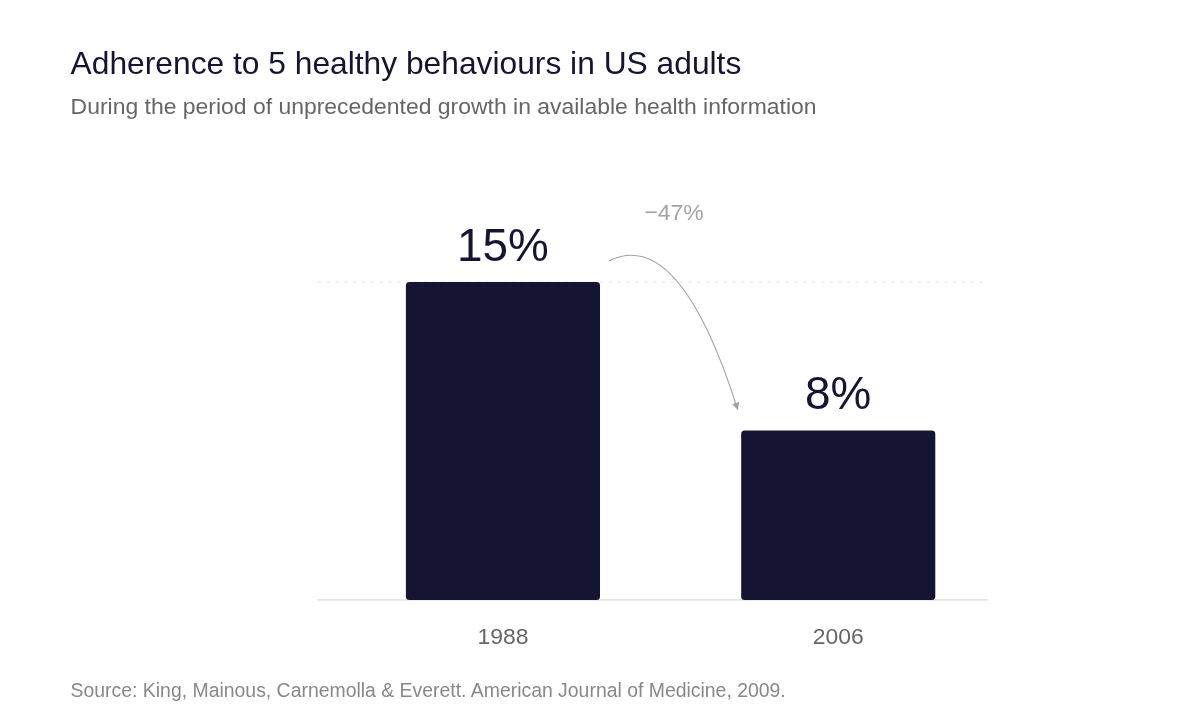
Information is not a factor for many people. Knowing has never been the bottleneck.
The Only Bit of Good News
I often use the example of The Flameheads in Challenge The Frame: They’re the ones scared of change. Clinging on to “The way it’s been done before.”

In our business and personal lives (but maybe not societally), we hold on to the past because it’s safe. We know the outcome of continuing to do the things, or hold the beliefs, that we’ve always done and had. And that keeps us stagnant.
We can often refuse to do the thing we already know we should do, because doing the thing is uncomfortable, and not doing the thing is familiar.
Welcome to the human condition. Welcome to your business. Welcome to my freezer at 9pm.
But, there is a muscle that closes this gap. The same muscle in the gym, the boardroom, the kitchen, your kid’s investment plan, and your knowing-doing list.
The muscle is doing the hard thing once. Then doing it again. Then doing it tomorrow. It’s hard at first. That’s how muscles work. If it weren’t hard, it wouldn’t be *different (*you’d already be good at it), and it wouldn’t change anything. The thing on your list has been on your list for 112 years because it’s hard. If it were easy, it’d already be done.
The good news is hard things get easier. The bad news is the only way to find that out is to do them.
Three things that Help Close The Gap
- Make it stupidly small. Not “go to the gym.” But rather, put on the shoes. Not “raise prices on all clients.” Open the email to one client. The brain doesn’t resist small things; it resists big things dressed up as small things.
- Specify when. Not “I’ll do it this week.” Tuesday at 10:30am. People who specify when and where they’ll do something are roughly two-to-three times more likely to actually do it than people who just intend to do it.
- Tell one person before you do it. Not Instagram. One person, by name, who’ll ask you about it on Friday. Public commitment to one accountable human is one of the most reliably tested behaviour-change levers in the literature.
None of this is new info.
This works because it lowers the bar to starting, not the bar to finishing.
Which leads us to our One Thing.

This Week’s One Thing is uncomfortable. Soz/not soz.
Pick one item from your knowing-doing list. Just one. The one that’s been there longest. The one you keep saying “I should…” about and then somehow never get around to. The one where you already have all the information you need.
Don’t research it more. Don’t optimise the plan. Don’t pick the best version of doing it. Don’t read another article about it.
Do the smallest workable version of it once. In the next 48 hours.
Send the email. Have the awkward sentence. Raise the price on one client. Call one lapsed customer. Skip the dessert once. Save fifty bucks. Write the first paragraph of the SOP.
You are not trying to fix the thing. You are trying to break the seal between knowing and doing. Just once. Every time you cross that gap, the gap shrinks slightly.
That’s the actual work. Everything else is study.
Annnnnd, GO!
Tell me how you went on LinkedIn. I read the messages.
Glad you’re here.
Ben
#BeAVillager
P.S. The smartest people I’ve worked with are not better than the rest of us at knowing. They’re better at doing what they already know. That’s a bigger gap than an IQ gap. And it’s a gap that practice closes.
You’re closer to the “smart people” than you think. The difference is one item, knocked off the list, today.
Sources & Further Reading
Pfeffer, J. & Sutton, R.I. (2000). The Knowing-Doing Gap: How Smart Companies Turn Knowledge into Action. Harvard Business School Press.
Suldovsky, B. (2016). “The Knowledge Deficit Model and Science Communication.” Oxford Research Encyclopedia of Communication.
Simis, M.J., Madden, H., Cacciatore, M.A., & Yeo, S.K. (2016). “The lure of rationality: Why does the deficit model persist in science communication?” Public Understanding of Science, 25(4).
Nyhan, B., Reifler, J., Richey, S., & Freed, G.L. (2014). “Effective Messages in Vaccine Promotion: A Randomized Trial.” Pediatrics, 133(4).
Nyhan, B. & Reifler, J. (2015). Vaccine, 33(3), 459–464.
King, D.E., Mainous, A.G., Carnemolla, M., & Everett, C.J. (2009). “Adherence to healthy lifestyle habits in US adults, 1988–2006.” The American Journal of Medicine, 122(6), 528–534.
For BJ Fogg / Make it stupidly small:
Fogg, BJ (2020). Tiny Habits: The Small Changes That Change Everything. Houghton Mifflin Harcourt. ISBN 978-0358003328.
https://www.gsb.stanford.edu/insights/building-habits-key-lasting-behavior-change
For Peter Gollwitzer / Implementation intentions:
Gollwitzer, P. M. (1999). “Implementation intentions: Strong effects of simple plans.” American Psychologist, 54(7), 493–503.
Free PDF of the original paper: https://www.prospectivepsych.org/sites/default/files/pictures/Gollwitzer_Implementation-intentions-1999.pdf